

Overall Population

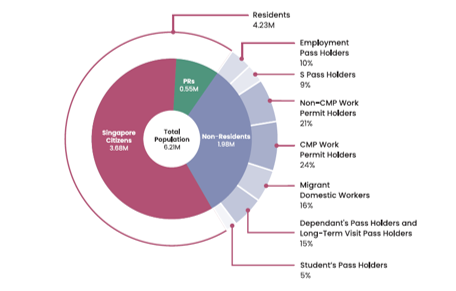
Singapore’s total population stood at 6.21 million as at June 2026 (Diagram 1), a 1.6% increase from June 2025. The increase was mainly due to growth in the Non-Resident population, particularly an increase in the number of Work Permit Holders in the Construction sector to support infrastructure projects such as Changi Terminal 5, Marina Bay Sands expansion, and the ramp up of housing supply and other transport infrastructure.
Diagram 1: Total population, as at June 2026[1]
Source: Department of Statistics, Ministry of Manpower
Figures may not sum up due to rounding.
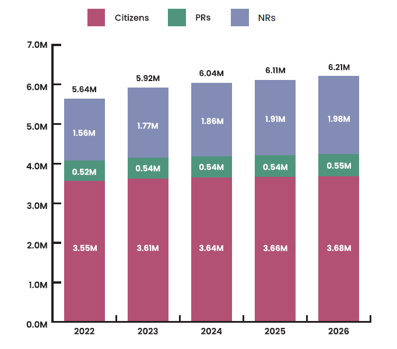
The citizen population increased by 0.7% from 3.66 million in June 2025
to 3.68 million in June 2026, while the Permanent Resident (PR) population
remained relatively stable at 0.55 million in June 2026 (Chart 1).
Chart 1: Total population by residency status, as at June 2026[2]
Source: Department of Statistics
Figures may not sum up due to rounding.
The Non-Resident (NR) population is diverse, and its size and composition vary over time to support our evolving economic and social needs. Today, the foreign workforce makes up about two-thirds of the NR population, while the remaining one-third comprises mainly Migrant Domestic Workers (MDWs), dependants, and students.
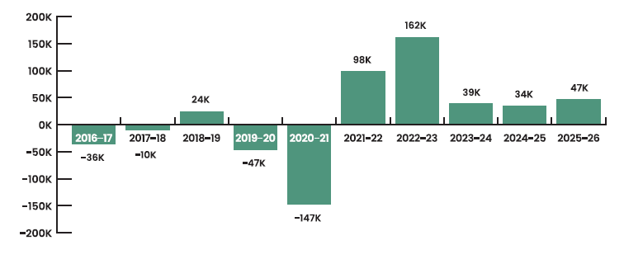
As at June 2026, the NR population stood at 1.98 million, an increase of 3.7% from June 2025. The increase in the NR population came primarily from Work Permit Holders, followed by MDWs. Foreign employment growth in Singapore was higher over the period of June 2025 to June 2026, compared to June 2024 to June 2025 (Chart 2), primarily due to increases in WPHs.
Chart 2: Change in foreign employment, as at June 2026[3]
Source: Ministry of Manpower
These figures are from the Population in Brief 2026 publication, which provides key updates and trends on Singapore’s population.
[1] Singapore residents comprise citizens and PRs.
Employment Pass Holders are benchmarked to Professionals, Managers, Executives and Technicians (PMET). The monthly qualifying salary for an Employment Pass is $5,600 for applicants at age 23. This increases progressively with age, up to $10,700 at age 45 and above. A higher qualifying salary applies for the Financial Services sector.
S Pass Holders are skilled foreign workers benchmarked to Associate Professionals and Technicians. The monthly qualifying salary for an S Pass is $3,300 for applicants at age 23. This increases progressively with age, up to $4,800 at age 45 and above. A higher qualifying salary applies for the Financial Services sector.
Work Permit Holders are non-PMET foreign workers from approved source countries. Some work in the Construction, Marine Shipyard and Process (CMP) sectors (e.g. construction workers), and others work in non-CMP sectors (e.g. Services, Manufacturing).
Dependant’s Pass Holders and Long-Term Visit Pass Holders are mostly dependants of citizens, PRs, and Work Pass Holders.
[2] The basic count and profile of the population are based on a person’s place of usual residence i.e. de jure concept. Citizens or PRs who have a registered foreign address or have been overseas continuously for 12 months or more prior to the reference date (i.e. June each year) are not included in the count for citizen and PR population.
[3] To provide a clearer picture of foreign workforce growth related to economic sectors, MDWs are excluded from the figures due to the distinct nature of their employment. Unlike other sectors where foreign workers contribute directly to industries such as Construction, Manufacturing and Services, MDWs work in households, performing domestic tasks.