

Longevity

Photo credits: Ministry of Health
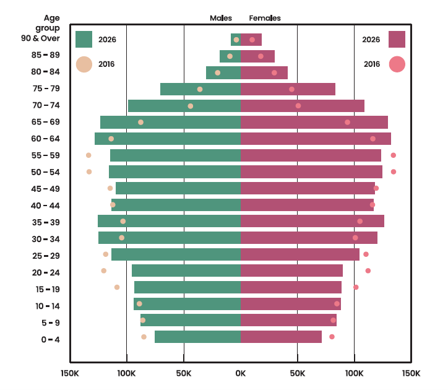
The proportion of our citizen population aged 65 years and above is rising, and at a faster pace compared to the last decade. Large cohorts of “baby boomers” continue to enter the post-65 age range (Chart 6)[1,2].
Chart 6: Age profile of citizen population, as at June 2026
Source: Department of Statistics
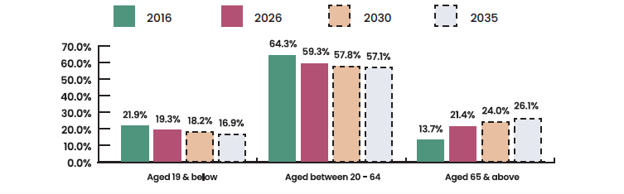
Singapore has become a super-aged society as the proportion of citizens
aged 65 and above was at 21.4% in 2026, an increase from 13.7% in 2016.
By 2035, it is estimated that more than 1 in 4 citizens will be aged 65
and above (Chart 7).
The proportion of citizens aged 20–64 is expected to remain broadly stable between 2030 and 2035. This is due to smaller cohorts ageing into the 65 and above age band, balanced by an inflow of younger cohorts into the 20 to 64 age band, including from managed immigration inflows.
Chart 7: Citizen population by broad age bands, as at June 2026[4]
Source: Department of Statistics. Figures may not sum up due to rounding.
The Government has implemented several initiatives to enable and encourage
seniors to remain in productive employment:
· We have been steadily raising the statutory retirement and re-employment ages to support seniors who wish to continue working and are able to do so. In 2026, the retirement age increased from 63 to 64, while the re-employment age increased from 68 to 69. The retirement and re-employment ages will be raised to 65 and 70 respectively by 2030.
· We also support senior workers to remain productive and employable. For example, the Career Conversion Programmes support individuals (including seniors) to reskill and take on new job roles with good prospects. The Mid-Career Pathways Programme supports mature workers aged 40 and above to transit into new sectors through a full-time attachment to gain industry-relevant skills and experience.
The Government also encourages employers to hire senior workers, to tap on their experience and expertise:
· Under the Senior Employment Credit (SEC), employers can receive wage offsets of up to 7% for Singaporean employees aged 60 and above and earning below $4,000 a month.
· The Part-Time Re-employment Grant
(PTRG) provides up to $125,000 in funding support to employers that commit
to providing part-time re-employment, flexible work arrangements and structured
career planning to senior workers.
These whole-of-society efforts are further complemented by Age Well SG,
our national programme that lays out further moves to weave together social
and health services in local communities around our seniors. By helping
seniors stay healthy, socially engaged, and supporting those who wish to
work for longer to do so, we can age successfully as a society.
Ageing must continue to be redefined as a positive force, so that Singapore
remains a place where Singaporeans can age well in. Everyone can play a
part, to build an inclusive society that celebrates seniors in Singapore,
and to turn silver into gold.
Visit https://www.agewellsg.gov.sg/ for
more information.
[1] The benchmark of 65 years is aligned with international statistical definitions.
[2] “Baby boomers” are defined as those born from 1946 to 1964. As such, they would be aged between 51 and 69 in 2015, and 61 and 79 in 2025.
[3] The United Nations defines a country as ‘super aged’ once the share of its population aged 65 and above reaches 21%.
[4] The 2030 and 2035 numbers illustrate the possible change in the population that could occur if certain demographic assumptions prevail over the stated period. These assumptions may or may not be realised. Projections have been updated from Population in Brief 2025.